MUNNAR NEWS
Munnar's Hidden Wildlife Richness Comes Into Focus as Survey Documents 106 Amphibian and Reptile Species
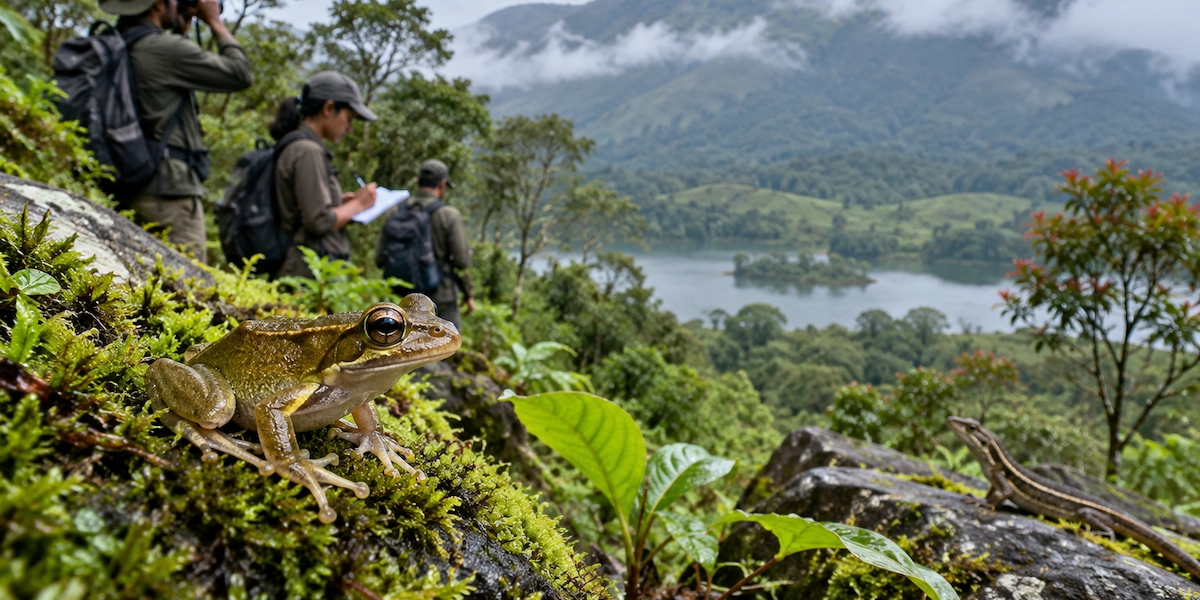
Image: AI-generated illustration
MUNNAR, KERALA: Munnar's forests and high-altitude ecosystems have once again demonstrated their remarkable biological richness, with a recent scientific survey documenting 106 species of amphibians and reptiles across protected areas of the Munnar Wildlife Division.
Conducted over four days, the biodiversity exercise recorded 54 amphibian species and 52 reptile species, offering a detailed picture of the lesser-known wildlife that inhabits Munnar's shola forests, mountain grasslands and other protected habitats.
The survey also produced several important additions to earlier biodiversity records. Researchers documented four amphibian species and three reptile species not recorded in previous surveys, underscoring the need for continued scientific exploration of the Munnar landscape.
An Important Finding in Eravikulam
Among the notable observations was a significant population of the Anamudi bush frog in the Eravikulam National Park landscape.
The finding is particularly important from a conservation perspective because the species is vulnerable to environmental changes and climatic pressures. The Munnar high ranges, therefore, continue to hold considerable importance as a habitat for species with highly restricted distributions.
Eravikulam and the surrounding high-altitude protected forests form part of one of the Western Ghats' most distinctive mountain ecosystems, supporting wildlife adapted to specialised climatic and habitat conditions.
Survey Highlights the Importance of Continued Documentation
The latest exercise covered protected landscapes managed under the Munnar Wildlife Division, including major national parks and wildlife habitats in the High Ranges.
Such surveys are important because many amphibians and reptiles remain difficult to observe and can easily go undocumented without systematic field studies. Their presence and distribution can also provide valuable information for scientists and forest managers studying changes in habitats and ecosystems.
Munnar's wildlife is often associated with iconic species such as the Nilgiri tahr. However, the latest findings draw attention to another important aspect of the region's natural heritage—the extraordinary diversity of frogs, snakes, lizards and other smaller wildlife.
The wider Munnar landscape is recognised for its rich reptile diversity, while ongoing scientific work has also highlighted the importance of the region for threatened amphibian species.
More Species Than the Previous Survey
The new findings also indicate an increase in the number of species documented compared with the previous joint survey conducted in 2022, when 52 amphibian species and 47 reptile species were recorded.
The difference does not necessarily mean that all the additional species are newly arrived in Munnar. Instead, continued and more detailed field documentation can improve scientific understanding of species that already occur within the landscape but had not previously been recorded during earlier survey exercises.
The latest findings therefore add valuable information to the growing biodiversity database of the Munnar Wildlife Division.
A Valuable Reminder for Munnar Conservation
The survey comes as an important reminder that Munnar's natural wealth extends far beyond its popular tourism attractions.
The region's forests, streams, grasslands and mountain habitats support a complex web of life, including species that receive far less public attention than larger mammals. Protecting these habitats is essential not only for individual species but also for maintaining the ecological character of the High Ranges.
As scientific surveys continue to expand knowledge of Munnar's wildlife, the latest documentation of 106 amphibian and reptile species adds another significant chapter to the story of one of Kerala's most biologically important mountain landscapes.